There is a particular kind of quiet tragedy that unfolds in glove compartments, gym bags, and sun-drenched windowsills across the country every single day: a perfectly good THC vape cartridge, meticulously formulated and rigorously tested, slowly degrading into a shadow of what it was designed to be. The consumer rarely notices the moment it happens. There is no dramatic event, no obvious spoilage, no smell that announces the loss.
Instead, there is simply a gradual erosion of everything that made the cartridge worth buying in the first place the vivid terpene expression, the clean pull, the consistent potency from first draw to last. By the time the degradation becomes obvious on the tongue, the damage has usually been accumulating for weeks. Understanding how to store THC vape cartridges properly is not a matter of paranoid over-caution. It is a matter of basic respect for the chemistry you paid for.
To Buy THC Vape Cartridges Click Here
Recommended products
-
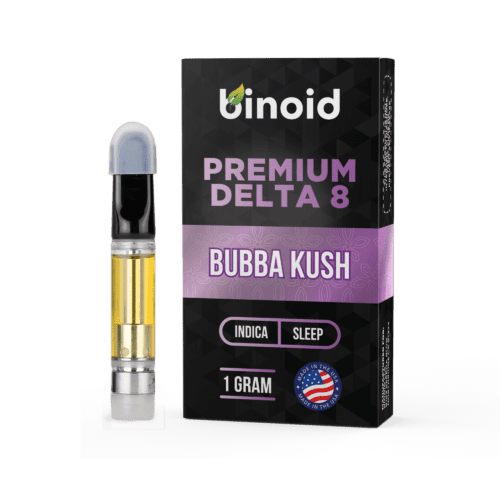
Delta 8 THC Vape Cartridge – Bubba Kush
$26.99$59.99 -
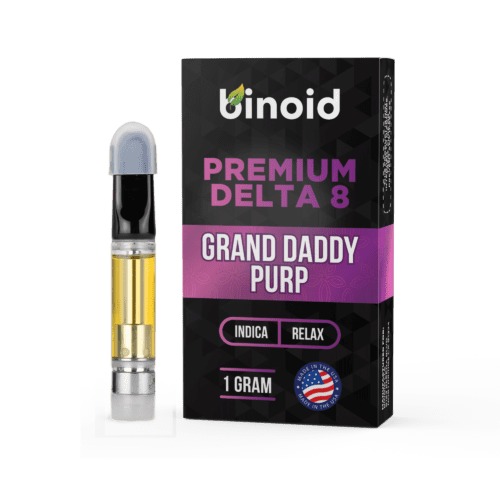
Delta 8 THC Vape Cartridge – Grand Daddy Purp
$26.99$54.99 -
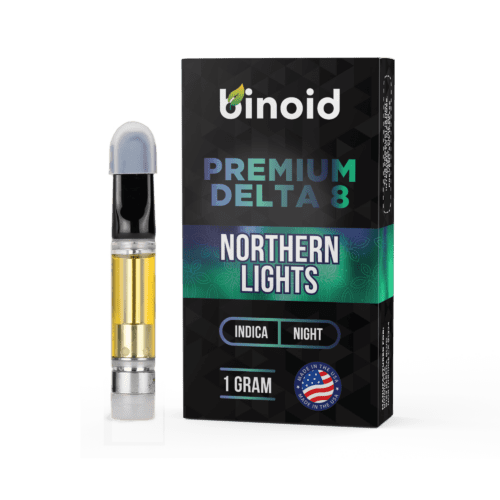
Delta 8 THC Vape Cartridge – Northern Lights
$26.99$59.99 -
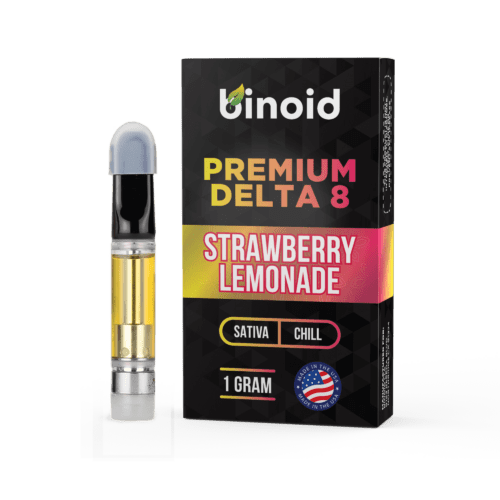
Delta 8 THC Vape Cartridge – Strawberry Lemonade
$25.99$54.99
The Cartridge as a Chemistry Experiment You’re Carrying in Your Pocket
A vape cartridge is, at its core, a sealed vessel containing a precisely engineered liquid extract typically a distillate or live resin formulation suspended in a viscosity that has been carefully calibrated to wick correctly through a ceramic or quartz coil. That precision is the entire value proposition. Every variable in the formulation, from the cannabinoid concentration to the terpene ratios that define a given profile, has been dialed in by a formulator who assumed the product would be handled with a baseline level of environmental care between the point of purchase and the point of consumption. When that assumption is violated when the cartridge spends an afternoon in a hot car or a winter week in a freezing coat pocket the chemistry inside begins to drift away from what the formulator intended, and it does not drift back on its own.
The primary aggressor in this drift is heat, and its mechanism of damage is deceptively simple: terpenes are volatile aromatic compounds, which is precisely why they smell and taste the way they do, and volatility is a double-edged property. The same molecular characteristic that makes a terpene profile vivid and expressive at room temperature makes it prone to evaporating prematurely when exposed to elevated temperatures. A cartridge left on a car dashboard in July can lose a meaningful percentage of its terpene content within a single afternoon, and that loss is not cosmetic.
It flattens the flavor, dulls the aromatic complexity, and because terpenes are believed to play a meaningful role in shaping the character of the broader cannabinoid experience through what the industry calls the entourage effect it can subtly alter the felt quality of the experience itself, not just its taste. This is chemistry, not marketing language, and it is precisely why BinoidCBD.com formulates its cartridge lineup with terpene stability as a design consideration from the outset, rather than treating flavor as an afterthought bolted onto a generic distillate base.
Recommended products
-
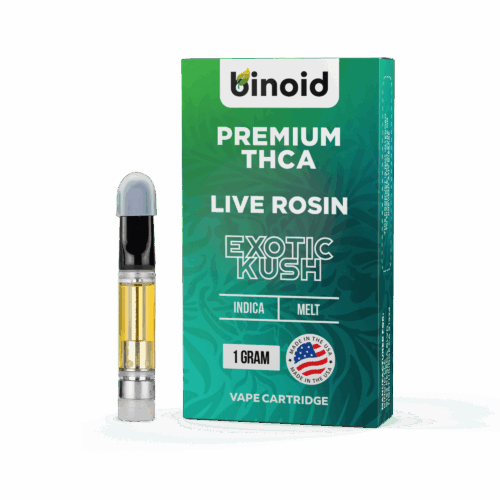
THCA Vape Cartridge – Live Rosin
$30.99$59.99 -
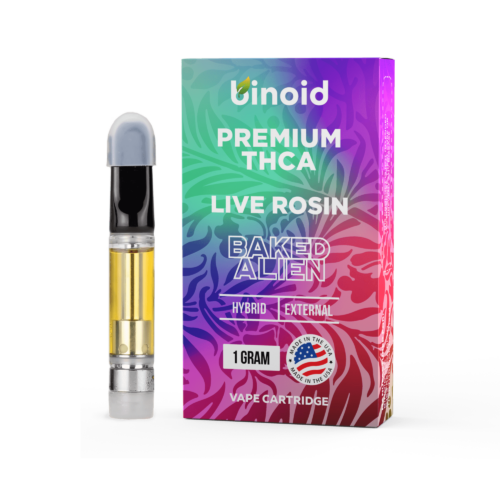
THCA Vape Cartridge Baked Alien – Live Rosin
$30.99$59.99 -
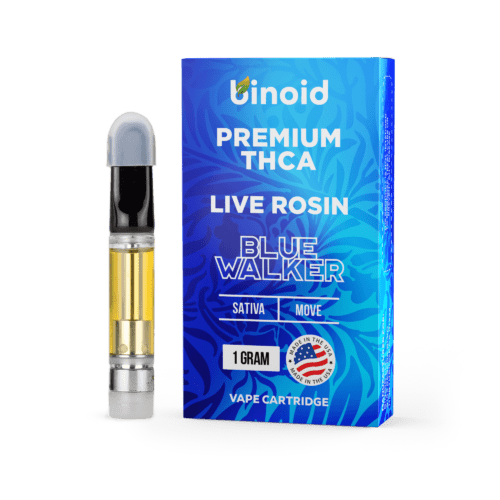
THCA Vape Cartridge Blue Walker – Live Rosin
$30.99$59.99 -
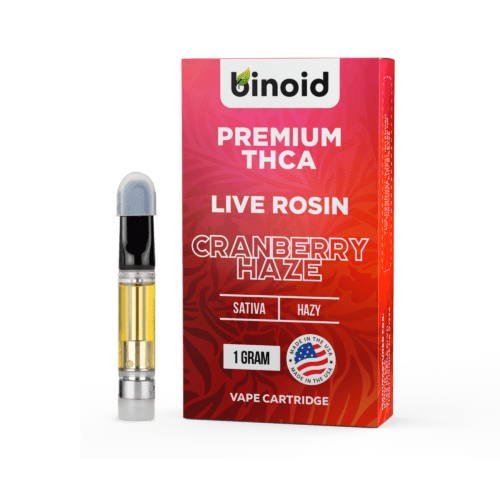
THCA Vape Cartridge Cranberry Haze – Live Rosin
$30.99$59.99
The Physics of Viscosity: Why Orientation Actually Matters
Anyone who has stored a vape cartridge on its side or upside down for an extended period has likely encountered one of the more common and entirely preventable failure modes in this category: coil flooding. The mechanism is straightforward once you understand the underlying physics. Cannabis oil at room temperature behaves as a relatively thick, slow-moving liquid, and its position relative to the coil determines how it interacts with the wicking system that draws it toward the heating element during use. When a cartridge is stored upright, with the mouthpiece facing up, gravity keeps the oil pooled safely at the base of the tank, away from the coil and mouthpiece, exactly where it belongs until you’re ready to draw from it.
Store that same cartridge on its side, however, and the oil begins to migrate toward the mouthpiece and coil assembly over time, saturating the wicking material well beyond what the coil is designed to vaporize efficiently in a single pull. The result is the gurgling, uneven, occasionally liquid-in-the-mouth experience that vape users learn to associate with a “flooded” cartridge an experience that has nothing to do with the quality of the oil itself and everything to do with basic orientation neglect. This is one of the simplest and most consequential rules in the entire category: vertical storage, mouthpiece up, always. It costs nothing, requires no special equipment, and single-handedly prevents one of the most common and most avoidable forms of cartridge degradation.
Temperature Extremes in Both Directions: The Overlooked Cold Problem
Most storage conversations fixate exclusively on heat, and for good reason heat is the more common and more immediately destructive threat. But cold exposure presents its own, less discussed set of complications. Cannabis distillate and live resin formulations can develop visible clouding or partial crystallization when exposed to consistently cold temperatures, particularly in formulations carrying higher concentrations of specific cannabinoids that are more prone to crystallizing out of solution at lower temperatures. This is generally a cosmetic and texture issue rather than a potency-destroying one, and it is often reversible with gentle warming rolling the cartridge between your palms for thirty seconds is usually sufficient to restore clarity and smooth viscosity.
The more serious cold-related risk involves the hardware itself rather than the oil. Cartridge housings, particularly those constructed from glass paired with metal or ceramic components, can develop micro-fractures when subjected to rapid temperature swings moving quickly from a cold car into a warm pocket, for instance, creates thermal expansion stress at the seams and junctions where different materials meet. These micro-fractures are not always visible to the naked eye, but they can compromise the seal integrity of the cartridge over time, leading to leaking, air intrusion, or accelerated oxidation of the oil inside. The lesson here is one of consistency rather than avoidance of any single temperature: a stable, moderate environment, free from dramatic swings in either direction, is what actually protects the cartridge’s structural and chemical integrity over its useful life.
Light Exposure: The Damage You Can’t Taste Until It’s Done
If heat is the loud, obvious threat to cartridge longevity, light is the quiet one and it may be the most underestimated variable in the entire storage conversation. Ultraviolet and even ordinary visible light can drive photodegradation in cannabinoids and terpenes alike, breaking down molecular structures through mechanisms that are invisible in the moment but cumulative over time. This is precisely why quality cartridge packaging tends to favor opaque or tinted materials rather than clear plastic the manufacturer is making a design decision on your behalf that you should reinforce rather than undermine with your own storage habits.
A cartridge displayed on an open shelf, or left sitting on a sunlit counter between uses, is accumulating photodegradation exposure every single day it sits there, even if it never gets hot. The fix is almost absurdly simple: keep cartridges in a drawer, a cabinet, an opaque case, or their original packaging whenever they are not actively in use. This single habit, costing nothing beyond a moment of intentionality, does more to preserve terpene vividness and cannabinoid integrity over the medium term than almost any other storage intervention available to the average consumer.
Building an Actual System: From Single Cartridge to Full Collection
For the consumer who owns a single cartridge at a time, storage discipline is a matter of a few consistent habits: upright orientation, a dark drawer or case, and a location that avoids proximity to heat sources like radiators, sunny windowsills, or the interior of a parked car. But for the more serious enthusiast someone building out a rotation across multiple Delta 8, Delta 9, Delta 10, THC-P, or HHC cartridge formats, as many BinoidCBD.com customers do once they’ve found a brand whose potency and terpene consistency they trust a more deliberate system pays real dividends. A dedicated case with individual compartments, ideally lined with a light-blocking material and stored in a consistently cool location away from any appliance that generates ambient heat, transforms cartridge storage from an afterthought into a genuine extension of the quality standards the brand itself has already built into the product.
This matters more than it might initially seem, because the entire value proposition of premium hemp-derived vape products rests on a chain of custody that begins with supercritical CO2 extraction or careful live resin processing, continues through formulation and third-party lab verification, and is only completed at the moment of consumption. A meticulously extracted, precisely dosed, terpene-rich cartridge that has been degraded by careless storage delivers an experience that reflects the storage failure, not the manufacturing standard and that is a genuinely unfair outcome for a product that BinoidCBD.com has engineered with considerably more care than the storage habits of the average consumer typically extend to it.
The Certificate of Analysis and the Storage Conversation Nobody Connects
It is worth pausing on a connection that rarely gets made explicitly: the Certificate of Analysis (COA) that accompanies a quality cartridge the ISO 17025-accredited lab documentation confirming cannabinoid potency, terpene content, and a full safety panel represents a snapshot of the product at the moment of testing, not a permanent guarantee that persists regardless of how the product is subsequently treated. A COA showing a specific terpene profile and cannabinoid concentration is describing the cartridge as it left the facility. Poor storage doesn’t invalidate the accuracy of that testing; it simply means the product in your hand today no longer fully matches the document that was accurate on the day it was generated. This is, in a sense, the strongest possible argument for storage discipline: you are not just protecting a purchase, you are protecting the integrity of the specific molecular promise that the COA made on the manufacturer’s behalf.
BinoidCBD.com’s transparency around batch-specific COA documentation gives consumers an unusually clear baseline to work from you know precisely what you’re starting with, which makes the case for protecting it that much more compelling. A cartridge that begins as a rigorously tested, terpene-rich formulation deserves an ending that matches its beginning, and that ending is determined entirely by the choices made between unboxing and the final draw.
The Verdict: Small Habits, Disproportionate Returns
The complete picture of how to store THC vape cartridges properly turns out to be refreshingly unglamorous: keep them upright, keep them dark, keep them at a stable moderate temperature, and avoid the dramatic swings and prolonged exposures that quietly erode terpene vividness and cannabinoid integrity over time. None of this requires specialized equipment or significant expense. What it requires is the same kind of intentionality that a discerning consumer already brings to the purchasing decision itself the same instinct that leads someone to check a COA before buying, to seek out live resin formulations for their aromatic complexity, or to choose a brand like BinoidCBD.com specifically because of its documented commitment to sourcing and manufacturing standards. Extending that same care into the storage drawer is the final, often-overlooked chapter of getting the full value out of a product that was, from extraction to bottling, built to deliver considerably more than most consumers ultimately let it.
To Buy THC Vape Cartridges Click Here
Recommended products
-
THC-P Vape Cartridge – Aurora Indica
$30.99$59.99 -
THC-P Vape Cartridge – Super Harlequin
$29.99$59.99 -
THC-P Vape Cartridge – Trainwreck
$30.99$59.99