
The Problem Hiding in Plain Sight
Pour a glass of water and a spoonful of vegetable oil into the same container, and no amount of stirring will make them stay combined. The oil will always find its way back to the surface, driven by a molecular incompatibility that has nothing to do with effort and everything to do with basic chemistry. This kitchen-table demonstration happens to explain, almost perfectly, why the first generation of cannabis beverages was such a persistent disappointment. THC is a lipophilic compound — fat-loving, water-avoidant, structurally uninterested in dissolving into the aqueous base that makes up nearly all of a seltzer, soda, or sparkling water. For years, this single chemical fact was the ceiling on what a THC beverage could realistically be, producing drinks with inconsistent potency, a notoriously long and unpredictable onset, and a general sense that the category was more concept than finished product.
Nano-emulsification is the technology that broke through that ceiling, and it deserves a far more detailed explanation than the vague “fast-acting” language that shows up on most beverage packaging. Understanding how it actually works — at the molecular level, not just the marketing level — is the difference between choosing a THC beverage based on genuine formulation science and choosing one based on a label that sounds impressive but describes very little. It’s also, increasingly, the standard by which serious cannabinoid consumers are learning to evaluate an entire beverage category that didn’t meaningfully exist a decade ago.
To Buy THC Beverages Click Here
Breaking It Down: What Nano-Emulsification Actually Does to a THC Molecule
At its core, nano-emulsification is a mechanical and chemical process that reduces THC particles to an extraordinarily small size — typically measured in nanometers, which is roughly one-billionth of a meter, a scale so small that a single human hair is tens of thousands of nanometers wide by comparison. Manufacturers achieve this reduction through high-shear mixing, ultrasonic processing, or microfluidization, techniques that physically break large THC oil droplets into a fine, uniform dispersion. But size reduction alone doesn’t solve the fat-and-water problem; a smaller oil droplet is still an oil droplet, and it will still separate from water given enough time.
The second and more important part of the process is encapsulation. Each nano-sized THC particle is wrapped in an amphiphilic shell — a molecular structure with a water-loving exterior and a fat-loving interior, engineered specifically to bridge the divide between the cannabinoid and its aqueous surroundings. This shell allows the THC particle to remain suspended indefinitely in a water-based beverage without clumping, separating, or settling at the bottom of the can the way improperly emulsified cannabis oil inevitably does. The result looks, from the outside, like nothing more than a clear or lightly colored seltzer. What’s actually happening beneath the surface is a small feat of applied colloid chemistry, holding two chemically opposed substances in stable suspension through careful molecular engineering rather than sheer force.
Why This Changes Absorption, Not Just Appearance
The visual stability of a nano-emulsified beverage is only half the story, and arguably the less interesting half. The more consequential effect happens once the drink is actually consumed, because particle size dramatically affects how quickly and efficiently THC crosses biological membranes. Conventionally processed THC, delivered through a standard edible, has to survive a slow and somewhat unpredictable journey through the digestive system before undergoing first-pass hepatic metabolism — the liver’s processing of the compound, which converts a portion of delta 9 THC into 11-hydroxy-THC, a more potent metabolite responsible for the notoriously delayed and sometimes overwhelming onset associated with traditional edibles.
Nano-emulsified THC particles, by contrast, are small enough to be absorbed directly through the mucosal tissues of the mouth, throat, and upper digestive tract, bypassing a significant portion of that slow hepatic pathway. This is why nano-emulsified THC beverages are so frequently associated with a faster, more predictable onset — commonly reported in the range of fifteen to thirty minutes rather than the sixty-to-ninety-minute (or longer) delay typical of a conventional edible. It’s a meaningful practical distinction for a consumer trying to gauge dosing responsibly: a beverage that reliably signals its effects within half an hour is a fundamentally more manageable product than one that might not announce itself until well after a second can has already been opened under the mistaken impression that the first “didn’t work.”
The Consistency Problem Nano-Emulsification Actually Solves
Beyond onset speed, there’s a second and quietly more important benefit to proper nano-emulsification: dosing consistency. A THC-beverage that hasn’t been emulsified correctly is prone to exactly the kind of separation problem described at the very start of this discussion — cannabinoid oil drifting toward the surface or settling toward the bottom of the can over time, meaning that the first sip and the last sip of the same beverage can deliver measurably different doses. This is not a hypothetical concern; it’s one of the most commonly cited failure points across the broader hemp beverage category, and it’s a direct consequence of manufacturers using inadequate emulsification technology or skipping rigorous batch testing to confirm homogeneity.
Properly executed nano-emulsification, paired with real quality control at the manufacturing stage, essentially eliminates this problem by keeping THC particles uniformly and permanently dispersed throughout the liquid rather than merely suspended long enough to survive a shelf display. This is precisely the standard that Binoid CBD‘s beverage program has been built around, with formulations engineered at Binoidcbd.com to maintain particle stability across a product’s full shelf life rather than just its first few days off the production line. For a consumer, the practical payoff is straightforward: a can from the top of a case delivers the same dose as a can from the bottom, which is a deceptively difficult manufacturing standard to hit consistently and one that separates genuinely well-formulated beverages from the category’s more disappointing entrants.
Terpenes, Flavor, and the Collateral Benefits of Getting the Science Right
There’s an underappreciated secondary advantage to proper nano-emulsification that has nothing directly to do with THC potency: flavor integrity. Many cannabis beverages also incorporate cannabis-derived or botanically inspired terpene profiles to shape the sensory character of the drink, and terpenes share THC’s general aversion to water-based mediums. A beverage manufacturer using the same nano-emulsification infrastructure to stabilize both cannabinoids and terpenes can produce a drink where the aromatic complexity survives from can to consumption, rather than degrading or separating out along with poorly suspended cannabinoid oil. This is part of why well-formulated THC seltzers can taste genuinely good on their own merits, independent of their psychoactive content, while poorly emulsified competitors often taste flat, oily, or artificially masked with excessive sweetener to compensate for an unstable base formulation.
This is also where the broader manufacturing philosophy behind a brand’s beverage line becomes genuinely visible to the consumer, even without a chemistry background. A THC seltzer that pours clear, tastes clean and balanced from first sip to last, and produces a consistent, moderately fast-onset experience can por reasonably be assumed to have gotten the underlying emulsification science right. One that separates visibly in the can, tastes muddled or overly sweet, or produces wildly inconsistent effects from one can to the next is very likely cutting corners somewhere in that same process — and that shortcut is rarely limited to just the beverage line if it reflects a broader manufacturing standard.
What to Actually Look For When Evaluating a THC Beverage
Given how much of a beverage’s quality rides on emulsification technology that a consumer can’t see or taste directly, the certificate of analysis becomes the most reliable proxy available for verifying that the science has actually been executed properly. A COA from an ISO 17025-accredited laboratory should confirm both the total cannabinoid content per can and, ideally, reflect batch-consistency testing that speaks to whether that stated dose is genuinely uniform across a full production run rather than an average that individual cans might significantly deviate from. This is a higher bar than most beverage brands are prepared to meet with transparency, which makes it a genuinely useful filter for identifying the more rigorous operators in the category.
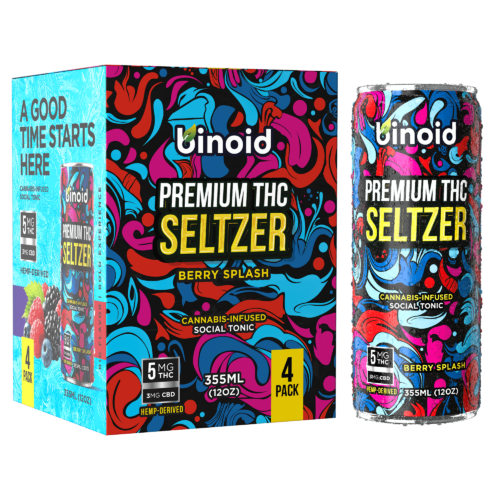
Binoid CBD publishes exactly this kind of batch-specific documentation across its full THC seltzer and Super 7 beverage lineup, giving consumers a way to verify — rather than simply hope — that the nano-emulsification technology underpinning the product has been executed to the standard the marketing implies. A beverage brand willing to put that level of testing transparency in front of consumers is signaling something important about its broader manufacturing discipline, and it’s a meaningfully different posture from brands that lean on vague “fast-acting” or “nano-infused” language without any batch-level data to back it up.
The Bigger Picture: Why This Technology Matters Beyond the Can
Nano-emulsification is, in the broadest sense, the technology that finally allowed cannabis to participate honestly in the beverage category rather than existing as an awkward guest wearing an ill-fitting costume. It solved a real chemistry problem — the fundamental incompatibility between a fat-loving cannabinoid and a water-based drink — through genuine materials science rather than clever marketing, and in doing so it opened up an entirely new consumption ritual for people who have never been particularly interested in smoke or vapor as a delivery method. The consumers gravitating toward this category tend to be exactly the kind of people who read ingredient labels and appreciate formulation transparency in every other product they buy, which means the beverage brands that take emulsification science seriously are, not coincidentally, the ones building the most durable consumer trust.
For anyone evaluating this category for the first time, the underlying lesson is a useful one to carry forward: a THC beverage’s quality is determined almost entirely by processes that happen before the can is ever sealed, and the only real window into those processes is rigorous, accessible lab documentation. Brands like Binoid CBD, operating through Binoidcbd.com, have built their beverage programs around treating that documentation as central rather than incidental — which is, in a category this dependent on invisible molecular engineering, close to the only honest way to earn a consumer’s confidence one can at a time.
To Buy THC Beverages Click Here
Recommended products
-
THC Seltzer – Good Vibes Bundle
$71.99$159.99 -
THC Seltzer – Good Vibes Cannabis Drink (4 Pack)
$19.99$29.99